

NC machine tool technology
NC Machine Tool Technology Numerical Control (NC) machine tool technology is a cornerstone of modern manufacturing, enabling precise, automated machining of complex parts. NC machines use programmed instructions to control tool movement, eliminating manual operation and significantly improving accuracy, repeatability, and efficiency. Core Principles NC machines operate based on coded instructions, typically written in G-code, which dictate tool paths, speeds, feed rates, and other parameters. These instructions are generated using Computer-Aided Manufacturing (CAM) software, which translates design data from CAD models into machine-readable commands. The machine's controller interprets these commands to drive motors and actuators, ensuring precise positioning of cutting tools relative to the workpiece. Key Components 1. Controller: The brain of the NC machine, executing programmed commands and coordinating movements. 2. Drive System: Includes servo or stepper motors that move the tool or workpiece along multiple axes (e.g., X, Y, Z). 3. Feedback System: Encoders or linear scales monitor position in real-time, ensuring accuracy through closed-loop control. 4. Cutting Tools: High-speed spindles with interchangeable tools perform operations like milling, drilling, or turning. 5. Workholding: Fixtures and clamps secure the workpiece during machining. Advantages - Precision: Tolerances within microns are achievable, critical for aerospace, medical, and automotive industries. - Flexibility: Quick reprogramming allows rapid transitions between different parts. - Productivity: Continuous operation reduces downtime and labor costs. - Complex Geometries: Multi-axis machines (e.g., 5-axis) can produce intricate shapes unattainable manually. Applications NC machines are used across industries: - Aerospace: Machining turbine blades and structural components. - Automotive: Producing engine parts and molds. - Medical: Fabricating implants and surgical instruments. - Electronics: Creating precision components for devices. Evolution & Trends Modern advancements include: - CNC (Computer Numerical Control): Enhanced with onboard computers for real-time adjustments. - IoT Integration: Smart machines with predictive maintenance and data analytics. - Additive Hybrid Systems: Combining subtractive and additive manufacturing. Conclusion NC machine tool technology revolutionized manufacturing by merging automation with precision. As innovations like AI and advanced materials emerge, NC machines will continue driving industrial progress, enabling faster, smarter, and more sustainable production.
Products
Category:
-
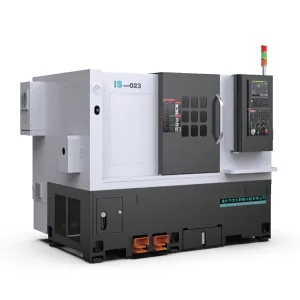
IS-023 High-Precision CNC Machine Tool
Category: IS SeriesBrowse number: 9Number:Release time: 2025-12-11 14:06:34IS-023 High-Precision CNC Machine Tool achieve fully automated control through computer programming and have three major characteristics that traditional machine tools cannot compare to: firstly, the machining accuracy can reach the micrometer level, and with 5-axis linkage technology, it can perfectly handle complex curved partsSecondly, NC machine tool technology adopt high-speed cutting technology, which can increase production efficiency by 3-5 times; More importantly, it has a fault self diagnosis function, which monitors parameters such as tool wear and temperature changes in real time t...
News
Category:
-
[Company News]Installation and commissioning process of IS-023 High-Precis...
2025-12-12 17:05:52
Case
Category:
No search results found!
Video
Category:
No search results found!
Download
Category:
No search results found!
Job
Category:
No search results found!
Featured Products
No search results found!



 Phone
Phone